Secure data destruction is an essential responsibility for organizations operating in Sweden. As regulatory expectations continue to mature, destroying information at the end of its life cycle reflects operational discipline. Your company is accountable for making sensitive data permanently unrecoverable.
The challenge is that modern environments rely on a wide range of data carriers, each with different risks and recovery characteristics. DIN 66399 provides clear criteria for classifying data sensitivity and matching it to appropriate destruction methods.
Explore what DIN 66399 is and why it matters for data destruction in Sweden.
What Is DIN 66399?
DIN 66399 is the German standard for secure data destruction. It provides a structured framework for destroying information stored on various media, including hard drives and solid-state devices. The rule ensures it is impossible to reconstruct sensitive data once it reaches the end of its life cycle.
DIN 66399 defines security levels that specify how thoroughly you must destroy information, in addition to protection classes that categorize data based on its sensitivity. This combination allows organizations to implement destruction processes proportionate to the data’s risk profile.
Why Is DIN 66399 Important for Data Destruction?
When you handle sensitive information, merely discarding old media isn’t enough. DIN 66399 provides a structured approach to reliably, verifiably destroying data. Its importance is multidimensional.
1. Compliance and Legal Necessity
The General Data Protection Regulation and other standards require Swedish organizations to render personal and sensitive data irretrievable once they no longer need it. DIN 66399 gives you a measurable way to meet these expectations.
By following its guidance, your destruction process can be a defensible part of your compliance strategy. Stakeholders can see that your approach meets recognized standards in various industries.
2. Standardization Across Media and Processes
Consistency is one of the challenges in data destruction. You might have hard drives or SSDs spread across different departments or locations, and without a standardized approach, it may be hard to properly destroy each media type.
DIN 66399 provides a consistent framework, ensuring you handle every piece of data according to a clear and quantifiable standard, regardless of its location.
3. Protection Against Breaches
When you follow DIN 66399, you reduce the chance that someone might recover discarded data. The standard defines security levels that determine the degree of destruction required for each type of data and media.
You don’t have to guess whether your process is sufficient because DIN 66399 provides the benchmark. This clarity lets you align your resources to the sensitivity of the information and gives everyone involved peace of mind that the data is truly irretrievable and won’t end up in the wrong hands.
What Do the DIN 66399 Security Levels Mean?
Understanding DIN 66399 helps you make decisions that protect your organization’s sensitive information while optimizing operational efficiency. Two elements are central — protection classes and security levels.
Protection Classes
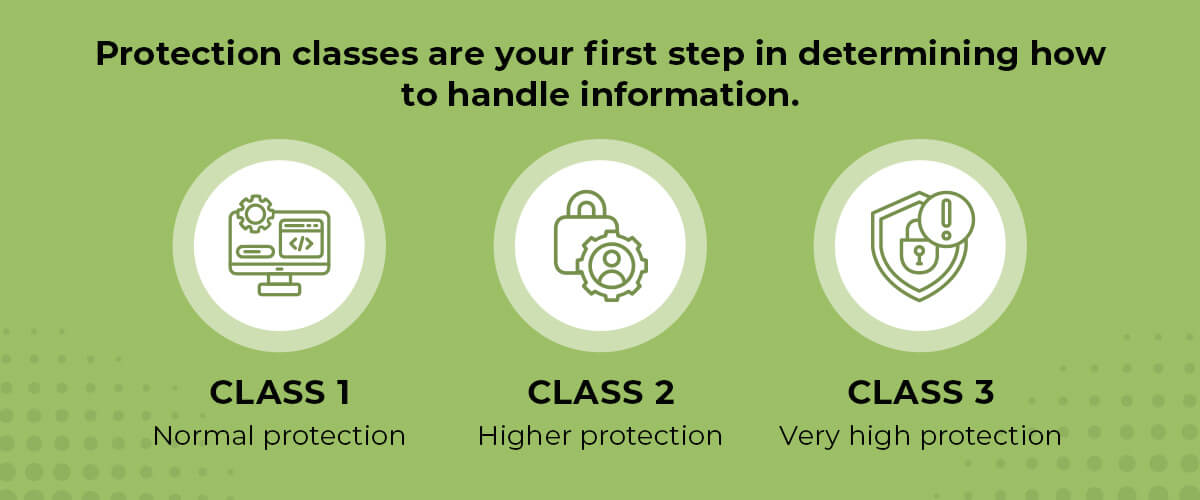
Protection classes are your first step in determining how to handle information. The table below represents these categories.
| Class | Description | Example Data |
| 1 | Normal protection | Nonsensitive internal IT system logs, publicly available digital marketing assets, outdated public-facing website content or routine digital interdepartmental communications on hard drives or SSDs. |
| 2 | Higher protection | Customer contact databases, internal financial reports, basic employee directory information, nondisclosure agreements, research data or routine operational audit logs residing on servers, hard drives or SSDs. |
| 3 | Very high protection | Patient records databases, detailed employee HR files, highly sensitive corporate legal documents, proprietary source code, critical intellectual property, classified government data, trade secrets or national security information stored digitally on high-security servers, hard drives or SSDs. |
Security Levels
Security levels define the intensity of destruction. Here are some security requirements for data destruction that require thorough shredding.
| Media Type | DIN 66399 Classification | Criteria/Standard | When to Use |
| Optical disks | O6 | Max 5 mm2 residual area | Strictly confidential information such as archived project data or proprietary software backups |
| Magnetic tapes | T6 | Max 10 mm² | Highly confidential information on magnetic tape backups, including critical system backups and long-term financial records |
| Hard disk drives | H6 | Max 10 mm² | Strictly confidential information on hard drives, such as server data and database backups |
| Electronic sticks and SSDs | E6 | Max 1 mm² | Highly confidential information on SSDs, USB sticks and memory cards |
What Happens if Data Isn’t Destroyed According to DIN 66399?
Failing to properly dispose of materials can expose your organization to risks on several levels.
- Data breaches and theft: Improper destruction allows people to reconstruct data from discarded media. Restored information can lead to potential exposure of sensitive customer records or internal strategic plans. Even seemingly low-risk items can be exploitable if they contain traceable information.
- Legal and financial penalties: Sweden’s GDPR framework requires companies to securely destroy personal and confidential data at the end of its life cycle. Failing to meet these obligations can result in fines or mandated corrective action.
- Reputational impact: Mishandled destruction can suggest negligence, which undermines relationships with stakeholders. Implementing DIN 66399-aligned processes shows that your organization conducts due diligence.
How Can Swedish Businesses Comply With DIN 66399?
Complying with DIN 66399 will enable your organization to create a reliable data destruction program that you can consistently execute and audit. Here’s how to approach it.
1. Identify and Classify Data Carriers
Not all media carry the same level of risk. Thoroughly inventory all data carriers and classify each according to its protection class.
Specific solutions can simplify this step. Products designed for mixed-media destruction allow you to manage different types of carriers through a unified workflow.
2. Choose the Appropriate Destruction Method
Once you’ve classified your data, decide how you’ll physically destroy the media. For some organizations, it makes sense to do this task in-house. When you routinely handle sensitive data, having access to dedicated destruction equipment allows you to control the process from end to end. Depending on the media involved, this may include solutions that destroy hard drives, disintegrate solid-state media, or sanitize magnetic storage. You can also opt for a combo disintegrator to effectively crush large quantities of hard drives and SSDs.
Use mobile destruction services for high-risk or regulated data. With this model, a dedicated data destruction company brings their advanced technology to your location, thus simplifying chain-of-custody management.
3. Integrate Processes With the Swedish Context
Meeting DIN 66399 in Sweden requires embedding your destruction practices into broader organizational and regulatory processes.
- Comprehensive documentation: Maintain certificates and logs for every destruction event. Modern services generate digital records that tie each destroyed item to a security level and protection class.
- Repeatable processes: Implement consistent workflows across sites. Some solutions offer integrated services that combine on-site and off-site destruction, tracking, and reporting to make repeatable compliance straightforward.
Meet DIN 66399 Data Destruction Standard With Reliable Solutions
Securely managing the end-of-life of sensitive information requires specialized tools and processes. Phiston Technologies offers a comprehensive range of data destruction solutions tailored to meet the security needs of companies across various industries.
If you manage a mix of media types, the MediaDice® All Media Disintegrator A2 provides all-in-one capacity, and the MediaDice® Combo Disintegrator allows you to efficiently handle large quantities of hard drives and SSDs.
The MediaDice® SSD Disintegrator-2C disintegrates a range of media, including SSDs, credit cards and USB drives, to a particle size of less than 2 mm to meet Class 3 DIN 66399 requirements and a high level of compliance.
Our solutions include on-site and off-site destruction options, complete with verification and certification. We also customize solutions to align with your operations and help you adhere to DIN 66399 requirements. With a local presence in Stockholm, we now support organizations across Sweden, Scandinavia and the broader EU with faster access to machines, mobile destruction and service support.
Contact us today to learn more.